PAGE 1 FREEDOM 2003

Nightmare in Jamaica!
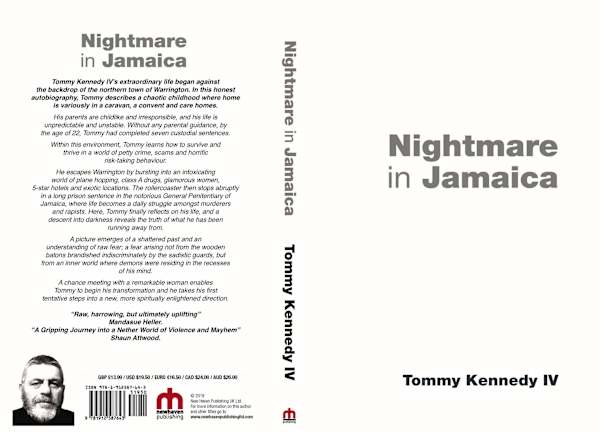
The sun blazed mercilessly over Kingston, Jamaica, in July 2003. Sweat stung my eyes as I stood before the rusted gate of the General Penitentiary Maximum Security Unit, a fortress of despair holding some of Jamaica’s most notorious criminals. The air reeked of decay, the walls pulsed with memories of violence and death, and every shadow whispered of survival against impossible odds.
A rasping voice broke the suffocating heat.
“Yo, Whiteman! When yuh touch down in England, tell dem seh mi innocent, yuh see?”
It was Dennis “Leppo” Lobban, a gaunt figure who'd sat on death Row. Convicted of three murders, including the brutal killing of reggae legend Peter Tosh, once of Bob Marley and the Wailers, Lobban’s hollow eyes held defiance and desperation. His words clung to me, sharp and haunting, a chilling reminder of the hopelessness within these walls.
My heart hammered with a single thought: Get me out of this hell.
For more than 700 days and nights, I endured this rat-infested Jamaican prison, a place where cruelty was routine and survival was never guaranteed. I saw men hacked apart in flickering cellblock light. I heard the relentless thud of fists and blades breaking bodies. I passed the feared Shower Posse gangsters who sprayed death with Uzi submachine guns, leaving victims crumpled in pools of blood. These were men who slit throats as casually as blinking, their cold stares promising no mercy.
When the Immigration Police finally arrived, their boots crunching on gravel, hope flickered but still felt fragile. I climbed into the metal prison van, the scorching seat searing my skin. As the gates groaned open, I looked back at Leppo. His silhouette was rigid, eyes burning into mine.
A faint smile tugged at my lips. I raised a hand in a fleeting wave—a final act of defiance against the nightmare I had barely survived.

Dennis “Leppo” Lobban: The Man Behind the Peter Tosh Murder
Some names walk into a room ten minutes before the man does.
Dennis “Leppo” Lobban was one of those names.
Long before I properly knew him inside General Penitentiary in Kingston, Jamaica, I knew the name.
Dennis Lobban.
Leppo.
The man convicted of murdering Peter Tosh, Jeff “Free I” Dixon and Wilton “Doc” Brown.
Three men dead.
Peter Tosh, one of the great voices of Jamaican music, gone.
A murder trial.
A death sentence.
Then life imprisonment.
That was Dennis Lobban on paper.
But paper is flat.
It tells you what happened in a courtroom. It gives you dates, charges, sentences and headlines.
It doesn't tell you what a man looks like when he is standing three feet away from you inside a Jamaican prison.
It doesn't tell you how he talks.
It doesn't tell you how he spends his days.
It doesn't tell you what happens to a human being after almost three decades behind bars.
And it certainly doesn't tell you that Leppo was small-framed, wiry and intensely committed to keeping himself fit.
He exercised constantly.
Press-ups.
Sit-ups.
Dips.
Whatever he could do inside the confines of his cell.
He would work until the sweat poured off him.
Then he would do it again.
He also spoke in thick Jamaican patois and was a dub poet.
That part of his story is often lost beneath the enormous shadow of Peter Tosh.
But I remember it.
I remember the voice.
I remember the rhythm.
And I remember making music and poetry with him through The Bloom of Light inside General Penitentiary.
That is the Dennis Lobban I knew.
The man in the newspaper
In September 2003, The Star newspaper in Jamaica published an interview with Lobban from inside General Penitentiary.
The headline was blunt:
“I DIDN'T KILL PETER TOSH.”
By then, Lobban had spent 16 years serving a life sentence for the murders.
He still maintained his innocence.
“I am innocent where this case is concerned,” he told reporter Yolande Gyles. “I have no knowledge about it. I was not there.”
Those are Lobban's words, not mine.
And that distinction matters.
I wasn't there on the night Peter Tosh was murdered.
I didn't see what happened.
I wasn't a witness.
I only knew the man years later, inside prison.
So when I tell this story, I am not pretending to solve a murder from decades ago.
I'm telling you what I saw and heard from a man who continued to deny responsibility for it.
Peter Tosh
Peter Tosh was never just another reggae singer.
He was one of the original Wailers, alongside Bob Marley and Bunny Wailer, before establishing himself as a major solo artist.
The Stepping Razor.
A hard voice.
A political voice.
A voice that didn't seem interested in making anybody comfortable.
His music dealt with oppression, racism, Babylon, police brutality and liberation.
He could be angry because he had something to be angry about.
On 11 September 1987, Tosh was shot dead at his home in Kingston.
Jeff “Free I” Dixon and Wilton “Doc” Brown were also killed.
The murders shook Jamaica and the international reggae community.
Lobban was subsequently convicted and sentenced to death before his sentence was later commuted to life imprisonment.
But Lobban always said he was innocent.
And in that 2003 interview, he gave his own account of his relationship with Tosh.
It wasn't the story of two strangers.
He said he had known Peter since his youth in Trench Town.
He spoke about knowing Peter, Bob Marley and Bunny Wailer from his younger days.
He even remembered being a fan.
His favourite Peter Tosh song, he told the newspaper, was “Legalize It.”
There is something strange about reading those words now.
Because behind the conviction was a man who said he had known Peter Tosh since childhood.
When friends fall out
Lobban also spoke about a disagreement involving Tosh's Volvo.
According to his account, Tosh had gone abroad and left the car behind.
Lobban said he came across it while he was at Skateland in Half-Way Tree and discovered that somebody else had been driving it.
There was a dispute.
Later, the Volvo was involved in an accident.
When Tosh returned, Lobban said he told him what had happened.
It sounds like ordinary street-life stuff until you know how the story eventually ended.
Because years later, Peter Tosh would be dead.
And Lobban would be serving life imprisonment for his murder.
Lobban told The Star that despite the disagreement, he continued to visit Tosh and did not allow the argument to destroy their relationship.
That is his account.
And again, I wasn't there.
But it gives you a glimpse into the complicated relationship between the two men that rarely appears in the simplified version of the story.
The night Peter Tosh died
Lobban told the newspaper that he heard about Tosh's death while he was in Jones Town.
He said he had been at a grocery shop on Crooks Street with friends and the shopkeeper.
He said he stayed there until around 10pm.
Then he heard the news.
He described himself as surprised and astonished.
The rest of Jamaica was trying to understand what had happened.
Peter Tosh was dead.
And somewhere in Kingston, the story that would eventually put Dennis Lobban on trial was beginning to take shape.
Lobban's explanation for his conviction was simple.
He said witnesses had placed him inside Tosh's house and that they were lying.
He maintained that they had a reason to implicate him because of an earlier dispute involving someone close to Tosh.
The courts reached a different conclusion.
Lobban never accepted it.
Sixteen years later, he was still saying the same thing.
He hadn't killed Peter Tosh.
General Penitentiary
By the time I encountered Leppo inside General Penitentiary, the conviction had already become part of his identity.
That is what prison does.
The crime becomes the name.
The sentence becomes the man.
You can lose your identity beneath the weight of what is written on the paperwork.
But the person standing in front of you is still there.
Leppo was small.
Wiry.
Almost slight.
But there was an intensity about him.
He was a fitness fanatic.
I saw him exercising constantly.
The cell became his gym.
The prison gave him very little control over his circumstances, but his body was still his.
So he trained.
Press-ups.
Sit-ups.
Dips.
Repetition after repetition.
Sweat running down his back.
Then starting again.
I never asked him what was going through his head while he exercised.
Maybe he needed the discipline.
Maybe it kept him sane.
Maybe it was simply something he could control.
I don't know.
I only know what I saw.
And what I saw was a small man who refused to let his body waste away inside a prison cell.
Then there was the voice
Leppo spoke in thick Jamaican patois.
Proper patois.
Fast, rhythmic and completely natural.
You didn't need an instrument when Leppo started talking.
He was a dub poet.
That was his thing.
He didn't play guitar.
He didn't play bass.
He didn't sit behind a drum kit.
His instrument was his voice.
He understood rhythm.
He understood timing.
He understood how words could hit you.
And that voice became part of The Bloom of Light.
This is where my memories of Leppo move away from the newspaper reports.
Because I knew him as a prisoner, yes.
But I also knew him as a creative person.
Inside General Penitentiary, we were making something.
Poetry.
Music.
Ideas.
Noise.
Life.
It might sound strange from the outside.
It wasn't strange from inside.
When the walls are closing in, you need somewhere for your mind to go.
Creativity gave us that place.
For a little while, the prison wasn't the most important thing in the room.
We were.
The 2003 interview
There is something else in that old newspaper interview that stays with me.
Lobban spoke about forgiveness.
He told the journalist:
“I have nothing against the society because I was told to forgive, so I also forget everything.”
And then he talked about getting out.
Not escaping.
Not climbing the wall.
Walking through the gate.
“I am not going to go jump no wall. I want to walk through the gate.”
That sentence tells you something about the world he had been living in.
He had already spent years behind those walls.
He wanted to leave properly.
He wanted to see his family.
He wanted, in his own words, to “live some life”.
There is something painfully ordinary about that wish.
After all the headlines.
After the murder conviction.
After the death sentence.
After years behind bars.
He wanted to walk through a gate and live some life.
The contradiction
This is where I struggle with the neat version of prison stories.
People like simple answers.
Good people.
Bad people.
Victims.
Killers.
Guilty.
Innocent.
But human beings don't always fit comfortably inside those boxes.
I am not saying Dennis Lobban was innocent.
The court convicted him.
I am not saying he was guilty beyond what the legal record establishes.
I wasn't there.
What I am saying is that I knew a man who continued to insist he hadn't committed the crime.
I knew a man who exercised relentlessly in his cell.
I knew a man who spoke beautiful Jamaican patois.
I knew a dub poet.
I knew somebody who helped make The Bloom of Light.
And all of that existed alongside the enormous shadow of Peter Tosh.
Those things can exist together.
That is what makes the story uncomfortable.
And perhaps that is exactly why it is worth telling.
Peter Tosh's voice survived
Peter Tosh's music didn't die with him.
It couldn't.
His songs travelled further than the men who murdered him could ever have imagined.
His voice still reaches people who weren't even born when he was killed.
That is the strange power of music.
A human life can end.
A voice can remain.
And inside General Penitentiary, another voice was still fighting to be heard.
Leppo's.
The small-framed bloke with the huge patois.
The man who could turn words into rhythm.
The fitness fanatic sweating through another session inside his cell.
The prisoner who insisted he had been wrongly convicted.
The dub poet who became part of The Bloom of Light.
I knew the name before I knew the man.
Dennis Lobban.
Leppo.
The name carried the weight of Peter Tosh's murder into the prison long before I knew anything about the person behind it.
But eventually the headline became a human being.
And that is what I remember.
Not because I have forgotten Peter Tosh.
I haven't.
Not because the conviction doesn't matter.
It does.
But because prison taught me something that newspapers rarely do.
A man can carry a terrible story behind him and still be a human being standing in front of you.
You don't have to rewrite history to recognise that.
You don't have to excuse anything.
You simply have to look.
And I looked.
I saw Dennis “Leppo” Lobban.
I heard his voice.
I watched him train.
I heard his poetry.
And inside the darkness of General Penitentiary, we made something together.
The Bloom of Light.
That is the Dennis Lobban I remember.
The man behind the headline.