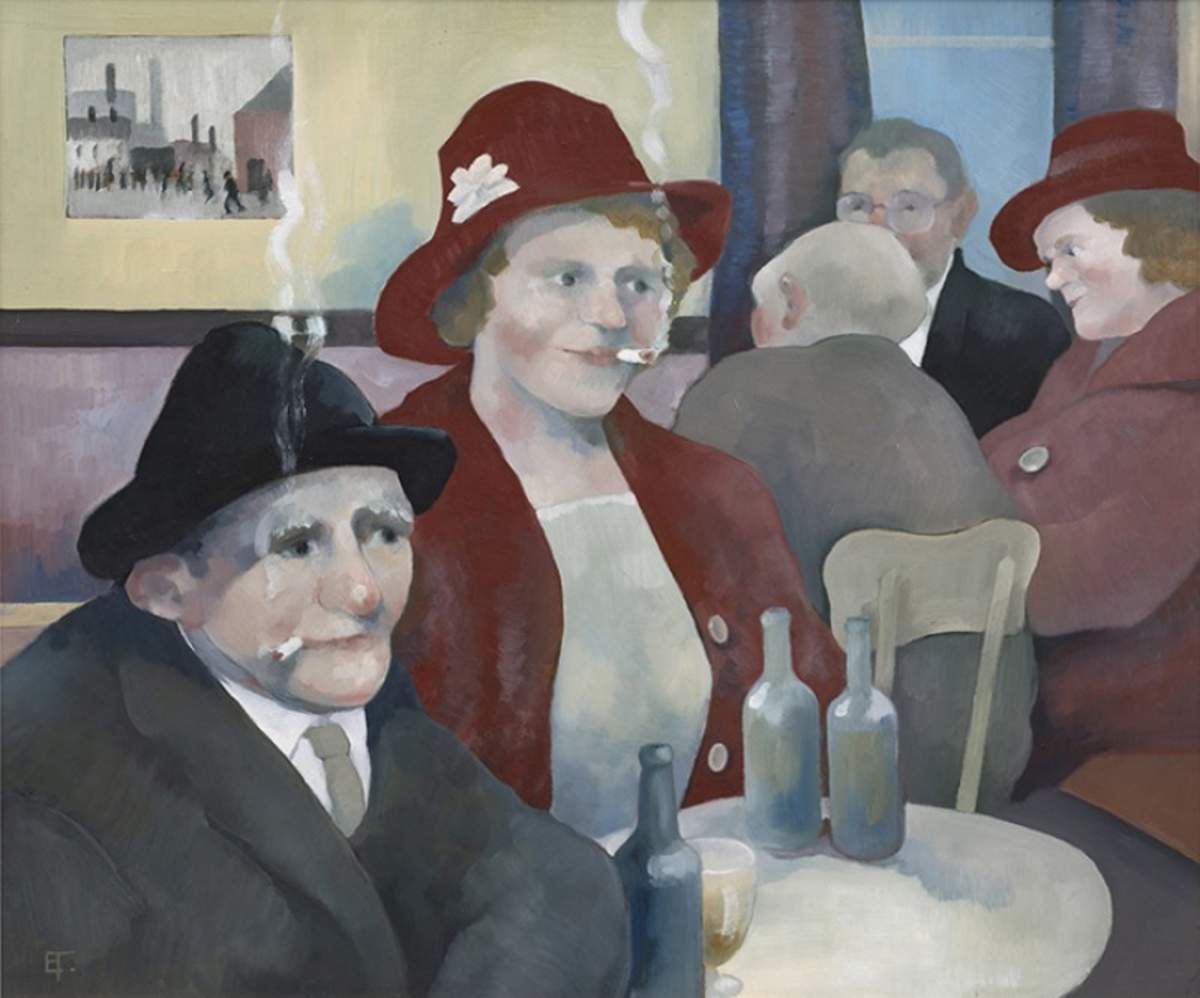


The Two Smokers depicted above by Artist Eric Tucker
Eric Tucker: The Secret Painter of Warrington
Some artists spend their lives chasing recognition. Others spend their lives quietly getting on with the job, without ever letting the outside world know what they're capable of.
Eric Tucker was one of the latter.
Born in Warrington on 13 May 1932, Eric was a working-class lad who left school at 14. He received no formal art education and spent much of his working life earning a living through manual labour. He worked on building sites, in factories and as a gravedigger. He was also a keen boxer, fighting as an amateur and briefly as a professional.
But there was another side to Eric's life that remained largely hidden.
From his late twenties onwards, he devoted himself to painting. His studio was the front room of the small terraced council house he shared with his mother and stepfather. There were no grand studios, no expensive surroundings and no art-world connections. Just Eric, his paints, his imagination and the world outside his front door.
He painted the Warrington he knew.
The pubs, back streets, factories, working men, women, drinkers, card players and colourful characters who made up everyday northern life. He also had an eye for circus performers, cabaret artists and people living on the fringes of society.
His paintings are full of personality. There is humour, sadness, eccentricity and an unmistakable affection for ordinary people. He wasn't painting some romantic version of working-class life. He was painting people as he saw them, with all their imperfections.
Eric was largely self-taught, but he took his art seriously. He regularly travelled to Manchester to visit its galleries and museums, studying the work of other painters. Artists such as Edward Burra and L.S. Lowry influenced him, although Eric developed a distinctive style of his own.
And here's the extraordinary part.
For decades, he kept almost everything to himself. Even members of his family had little idea of the sheer scale of his work.
When Eric died in July 2018, aged 86, his family discovered hundreds of paintings, watercolours and thousands of sketches hidden throughout his house. They found an extraordinary artistic legacy that had been quietly accumulating for years.
His family decided to honour his wish to have his work seen. They opened the house as a temporary gallery, and what followed surprised everyone. Thousands of people came to see the paintings.
Warrington Museum and Art Gallery subsequently staged a major retrospective, The Unseen Artist, in 2019. His work later attracted attention from London galleries, bringing his paintings to a much wider audience.
He was sometimes described as Warrington's secret Lowry, but I think there's something more interesting about that comparison.
Lowry painted the industrial North, but Eric Tucker painted from within the community he belonged to. He knew these people, drank in the same pubs and understood the places he was putting on canvas.
There is something rather wonderful about a man who spent his working life as a labourer, came home and painted into the early hours, without any great expectation of fame or fortune.
Eric Tucker never needed an art-world invitation to become an artist. He simply got on with painting.
And perhaps that's the most important part of his story.
A Warrington lad, largely unknown outside his own circle, left behind a remarkable record of the people and places that made up his world.
He may have been the Secret Painter during his lifetime, but his paintings are no longer a secret.
Eric Tucker (1932–2018). A Warrington original.