
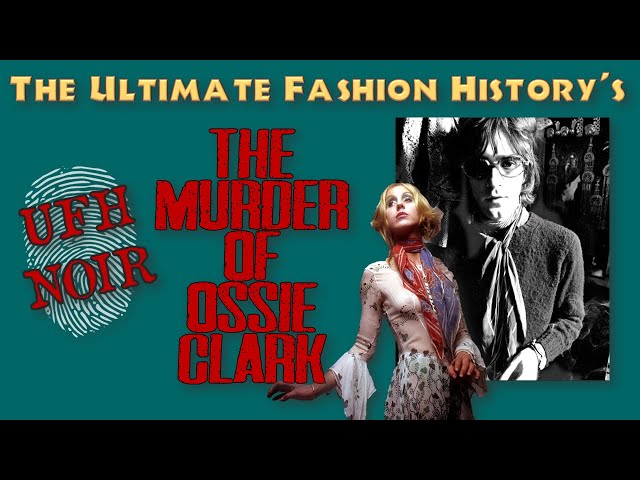

The late-summer sun of August 1996 was brutal, but inside that cramped council flat on the top floor of a block in Holland Park, the heat felt different. It was a pressure cooker of bad choices, cheap drugs, and faded glamour.
Ossie Clark sat there surrounded by the ruins of a life that had once set the fashion world on fire. In the 1960s and 70s, he was king of the King's Road. Mick Jagger, Marianne Faithfull, Twiggy—they all wore his flowing, romantic dresses. But by ’96, the party was long over. He was broke, lonely, and sharing his small space with a volatile 28-year-old Italian named Diego Cogolato.
The papers at the time called Cogolato an Italian "drifter." A lot of people in the local scene believed he was from Sicily, born into that sun-baked, ancient island landscape before finding his way to the grey, concrete edges of West London. He was young, troubled, and drifting. On the night of August 6th, the mix inside that flat turned lethal. A toxic cocktail of prescribed Prozac and street amphetamines triggered a sudden, psychotic break in the young Italian. In a frenzied attack, Ossie Clark’s brilliant, chaotic life was ended on his own floor.
When the Old Bailey trial wrapped up in March 1997, the court accepted a plea of manslaughter on the grounds of diminished responsibility. The Times reported that Cogolato genuinely believed he was the Messiah, that Clark was Satan, and that he had a message from God to kill him. Mr Justice Douglas Brown handed him a six-year stretch, noting the heavy role the drug interaction played in his psychotic state.
To the British press, that was the end of the story. A six-year sentence means you’re usually walking the streets again in three, and by the turn of the millennium, he had vanished into thin air. Most assumed he’d been quietly deported back to Italy, sent back across Europe to fade into obscurity.
But history has a strange way of doubling back on itself.
Cogolato didn’t go back to the Mediterranean. Instead, he slipped across the Irish Sea and set up shop in the heart of Dublin, finding a flat on Charlemont Street in Dublin 2. For nearly two decades, he stayed completely off the British media's radar, living a quiet, unassuming life with his partner, Derek Curran—until the old, dark volatility flared up again.
It’s July 28, 2016, a bright morning in the Dublin suburb of Rathfarnham. A local commuter is cycling down the designated lane on Dodder Road, just trying to get to work. Out of nowhere, an argument erupts. Two men walking down the lane block the path. According to Garda Christopher Moylan, words turn to shouting, and the pair lunge at the bicycle, tearing the commuter's bag. When the blue lights of the Gardaí flash in the distance, the pair bolt towards Bushy Park.
When the case finally wound its way through Tallaght District Court in 2018, the mask completely slipped. The man standing in the dock, convicted of threatening and abusive behaviour, wasn’t just an angry pedestrian. It was a 50-year-old Diego Cogolato.
The Irish court records, published by local Dublin outlets like Echo.ie, pulled back the curtain on a hidden life.
The young Italian who had killed a fashion legend in a drug-fueled London frenzy twenty years earlier had spent his middle age accumulating a staggering 28 separate convictions across Ireland. While his partner Curran received a suspended sentence and a fine, Judge Patricia McNamara noted from Cogolato's probation reports that he was still refusing to engage with the Probation Services, carrying whatever demons had followed him from London.
Ossie Clark’s dresses still hang in museums, frozen in the golden light of a bygone era. But the man who took his life is very much real, surviving in the gritty, rain-slicked streets of inner-city Dublin, a long, dark way from the Sicilian sun.